Dalton Highway in Winter: Road Conditions, Safety and Guided Tours
Can you drive Alaska's Dalton Highway in winter? Road conditions, closures, what to pack, the guided winter drives from Fairbanks and when an aurora tour fits better.
Yes, the Dalton Highway is open in winter, but driving it yourself is a remote-road expedition, not a scenic day out. The 414-mile road runs from Livengood, about 80 miles north of Fairbanks, to Deadhorse, crossing the Arctic Circle and the Brooks Range on the way. The state maintains it all year because trucks supply the North Slope oilfields along it. Ice, drifting snow, deep cold, poor visibility and long gaps between services make winter driving dangerous, and the Bureau of Land Management’s Dalton Highway visitor guide says travel between late October and early April is not advised. If you have not driven remote Arctic roads in winter before, book a guided trip from Fairbanks.
For most visitors the realistic winter goal is to cross the Arctic Circle and come back to Fairbanks the same night, not to drive all the way to Deadhorse. Guided winter drives and aurora drives run on set days through the season, and operators can change the route or turn back when conditions demand it.
The road does not close for the season, but short-notice closures, long delays and extreme conditions do happen. Check Alaska 511 right before you leave and keep checking on the way. If the northern lights are the reason for your trip, book a tour that sets aside time to watch for them; a winter sightseeing drive does not.
Check Availability
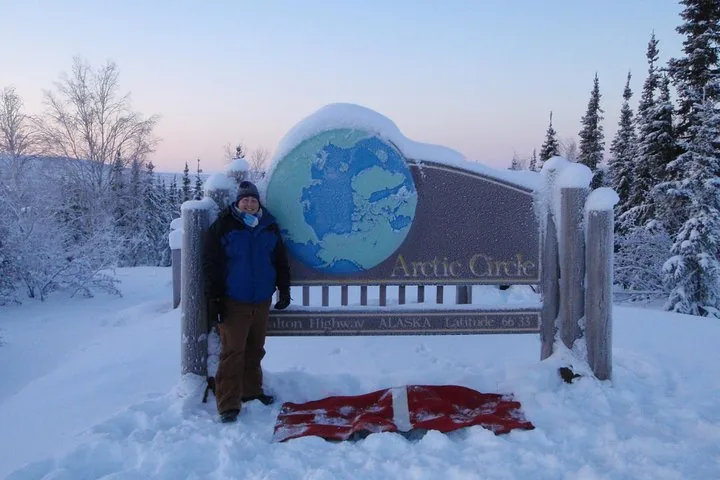
Arctic Circle Winter Drive Adventure
- 4.9/5 (160+ reviews)
- About 16 hours
- Operated by Northern Alaska Tour Company
Includes Professional driver-guide for the whole day · Live commentary on board about the road, the pipeline and life in the …
You'll choose your date and complete the booking on Viator.
Dalton Highway winter facts
| Question | Practical answer |
|---|---|
| Is the Dalton Highway open in winter? | Yes, all year, with temporary weather restrictions and closures. |
| Where does it begin? | Near Livengood, roughly 80 miles north of Fairbanks. |
| How long is the highway? | 414 miles from Livengood to Deadhorse. |
| Can you visit the Arctic Circle in winter? | Yes, when weather and road conditions allow. |
| How long from Fairbanks to the Arctic Circle? | The BLM plans on about five hours of driving each way in good conditions, 5 to 7 with stops, before any winter delays. |
| Can visitors drive it themselves? | Only with a suitable vehicle, written permission from the rental company, full winter kit and Arctic driving experience. The BLM does not advise it between late October and early April. |
| Can you see the northern lights? | Possibly, under dark, clear skies; no tour can promise them. |
| Better option for a first-time visitor? | A guided Arctic Circle winter drive or an aurora drive. |
What is the Dalton Highway like in winter?
The Dalton Highway, often called the Haul Road, was built to supply the Trans-Alaska Pipeline and the North Slope oilfields. Visitors can drive it, but its main job is still carrying freight and crews across remote Arctic Alaska.
From Fairbanks you first follow the Elliott Highway north before the Dalton itself begins. The country changes from boreal forest to open hills and, past Coldfoot, to the Brooks Range and Arctic tundra. Most of the road is gravel with some paved stretches, and the surface is rough even in summer.
In winter you add these hazards:
- Packed snow and ice: traction changes with the temperature, fresh snow and how recently crews have worked the road.
- Blowing and drifting snow: wind can wipe out visibility in minutes and leave drifts across the road.
- Extreme cold: the BLM says temperatures along the road frequently reach 30°F below zero and lower, and its visitor guide warns of windchills to -70°F. A breakdown far from services becomes an emergency.
- Short days: you drive long sections in the dark, especially in December and January.
- Heavy trucks: big rigs use the road all year and need plenty of room to stop.
- Closures: heavy snow and avalanches around Atigun Pass can stop traffic for days.
Alaska DOT&PF warns that winter conditions can begin as early as August and last into June. A calendar label such as “spring” or “fall” tells you little; check the conditions for your actual dates.
Official reference: Alaska DOT&PF, Dalton Highway. Our Dalton Highway guide covers the mileposts, fuel stops and the road in every season.
Other Experiences
Other experiences you might enjoy
Other Fairbanks departures that run in winter, from Arctic Circle drives on the Dalton Highway to aurora nights closer to town.

Does the Dalton Highway close in winter?
Not as a seasonal closure. The BLM says the road and the private services along it stay open all winter for trucks supplying the oilfields and camps, and state crews maintain the corridor.
Open does not mean safe for every driver on every day. Snowstorms, whiteouts, avalanches, accidents and slick surfaces can slow you to a crawl or close the road for a while. The Arctic Interagency Visitor Center in Coldfoot and the Yukon Crossing Contact Station are closed from September to May, so do not count on a visitor center being open in winter.
Check these official sources before you leave:
- Alaska 511, current road reports and alerts.
- Alaska DOT&PF, Dalton Highway.
- Dalton Highway maintenance and reporting.
- National Weather Service Alaska for forecasts and warnings; pick the interior or northern Alaska forecast area you will drive through.
Alaska 511 reports describe what was seen at a given time and place. They do not guarantee the state of every mile, so read them together with the weather forecast and your guide’s or operator’s advice.
Fairbanks to the Arctic Circle in winter: distance and time
The usual winter route is Fairbanks, the Elliott Highway, the Dalton Highway, the Yukon River crossing, the Arctic Circle sign, then back to Fairbanks.
The Arctic Circle sign stands near milepost 115 of the Dalton Highway, north of the Yukon River, about 199 road miles from Fairbanks. The BLM plans on about five hours each way in good conditions, and it suggests adding one to two hours for stops, wildlife and bad weather. A winter round trip takes much longer once road conditions, photo stops and meal breaks are added.
Do not plan the day by doubling a summer map-app time. Guided tours take most of the day and usually get back late at night or after midnight.
For the full route breakdown, read our guide to Fairbanks to the Arctic Circle.
Key landmarks on a winter Arctic Circle trip
Trans-Alaska Pipeline viewpoints. Much of the drive follows the pipeline corridor, and guides usually explain why it was built and how it copes with the cold.
Yukon River crossing. The bridge and the wide frozen river are among the highlights of the route. Check in advance whether food and restrooms are open there in winter.
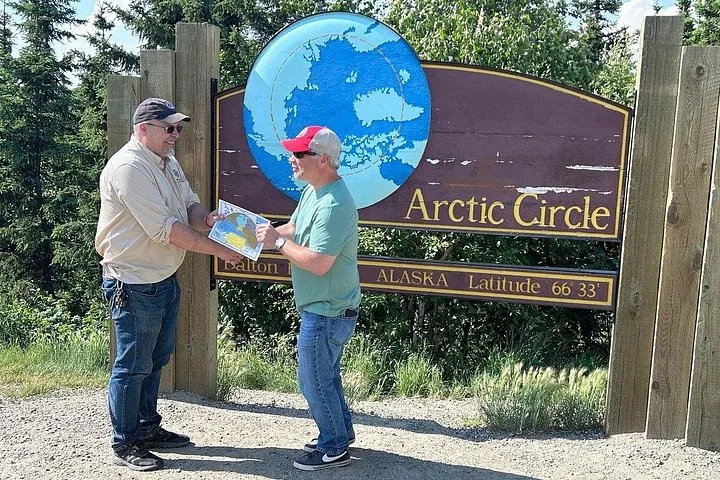
Arctic Circle sign. The classic photo marks about 66.5° north. Many tours hand out a crossing certificate.
Coldfoot. About 60 miles north of the Arctic Circle sign, Coldfoot is the service and lodging stop for longer Arctic trips. Most Arctic Circle day tours turn around at the sign.
Atigun Pass. Farther north still, the road crosses the Brooks Range at Atigun Pass. The pass is spectacular and very exposed to winter storms; do not treat it as a quick add-on to an Arctic Circle day.
Is it safe to self-drive the Dalton Highway in winter?
For a visitor without remote Alaska winter experience, self-driving is a high-risk choice. Conditions can defeat vehicles built for cold weather, and help can take a long time to arrive. On this road a guided tour is a safety decision as much as a convenience.
Alaska DOT&PF tells travelers to bring a reliable, well-equipped vehicle, spare tires, extra fuel, food, water, a first-aid kit, warm clothes and other emergency gear. Many rental companies prohibit the Dalton Highway or do not cover damage there. Get permission in writing; an “SUV” category on the booking does not count. Our self-drive vs tour guide covers rentals, tires and the CB radio.
Minimum questions to answer before considering a self-drive
- Does your rental agreement expressly allow driving the Dalton Highway in winter?
- Is the vehicle ready for extreme cold, with suitable tires, good mechanical condition and recovery equipment?
- Do you know how to handle a loss of traction, a sudden whiteout and a breakdown in deep cold?
- Will you carry enough supplies to shelter safely if the road becomes impassable?
- Do you have a communication and check-in plan that does not rely on mobile signal?
- Have you confirmed which fuel stops and services are open on your dates?
- Are you ready to postpone or turn back before reaching the sign?
If any answer is no, book a guided tour. A tour does not remove winter risk either, and operators can change or cancel a trip for safety.
What to pack for a winter Dalton Highway tour
Even on a guided tour in a heated vehicle you step out for short stops and photos, and you could be held up by a closure, so dress for the cold outside.
Clothing and essentials:
- Warm base layers and an insulating mid-layer.
- A wind-resistant insulated parka and winter pants.
- Insulated winter boots with good grip, and wool or thermal socks.
- A warm hat, a neck gaiter, and mittens or gloves with liners.
- Spare warm layers and cover for exposed skin.
- Personal medication, snacks and water, within the operator’s guidance.
- Phone and camera batteries, kept warm in an inside pocket.
- A power bank that works in the cold, and a headlamp.
Some operators lend specialist gear, but do not assume it is included. Read the booking details and ask what clothing you need before you go. Our what to wear guide goes through the layers piece by piece.
Guided Dalton Highway winter tours from Fairbanks
Winter Arctic Circle trips come in three different formats. Pick the right one, especially if you hope to see the aurora.
| Tour style | What you do | Suits | Time needed |
|---|---|---|---|
| Arctic Circle winter drive | Remote road journey, Yukon River, Arctic Circle crossing | Travelers who want the drive and the sign photo | About 16 hours |
| Arctic Circle aurora drive | The same crossing plus a set aurora watch on the way back | Travelers who want the Arctic Circle and a northern lights chance | 18 to 19 hours, back in the early morning |
| Arctic winter fly-drive | North by road, a night in Coldfoot, return by small plane | Travelers who want longer in the Arctic and less driving back | Two days |
Option 1: Arctic Circle Winter Drive Adventure
The Arctic Circle Winter Drive Adventure by Northern Alaska Tour Company is a guided round trip from Fairbanks up the Dalton Highway to the Arctic Circle, with stops at viewpoints including the Yukon River. It costs US$309 on Viator and is rated 4.9/5 from more than 160 reviews. The operator lists a 9:45 a.m. departure and a return around 1 to 2 a.m. on its scheduled 2026–27 dates. Booked direct, it costs $299 to $339 per person, depending on the date. The season runs to 21 April 2027. Read our Winter Drive breakdown for the full itinerary.
The operator says plainly that this is not an aurora tour. The driver may pull over briefly if the lights appear and there is a safe place to stop, but the tour does not wait for them.
Choose this tour if the drive and the Arctic Circle crossing matter more to you than time set aside for the northern lights.
Option 2: Arctic Circle Aurora Drive Adventure
The Arctic Circle Aurora Drive Adventure, from the same operator, adds a set aurora-watching stop outside Fairbanks on the way back. It costs US$369 on Viator, runs about 18 to 19 hours on the operator’s schedule, and is rated 4.6/5 from just over 30 reviews, a small sample. Northern Alaska Tour Company runs it at 9:45 a.m. on Sundays, Tuesdays and Fridays and gets back between 3:30 and 4:30 a.m.; direct prices for the 2026–27 winter are $359, or $399 on peak dates. Our Aurora Drive breakdown covers the stops.
This is the one to book if seeing the northern lights is a main reason for the trip and you can handle an exceptionally long outing. Whether you see them still depends on aurora activity and clear skies.
Some agencies resell this trip under other names, such as Alaska Tours’ Winter Arctic Circle Northern Lights Drive. It is the same Northern Alaska Tour Company departure, so check who operates a listing before you treat two names as two different tours.
Option 3: Arctic Circle Winter Fly-Drive
Northern Alaska Tour Company’s Winter Fly-Drive goes north by road, spends a night in Coldfoot and flies back to Fairbanks by small plane. You can add excursions during the Coldfoot stay. The operator’s 2026–27 prices for the northbound trip run from $679 to $879 per person on standard dates and $739 to $939 on peak dates. This trip is booked with the operator; it has no Viator or GetYourGuide listing. Our fly-drive tours page compares it with the aurora fly-drive versions.
This suits you if you want a longer stay in the Arctic instead of one exhausting out-and-back drive. Small-plane flights depend on the weather, so leave slack in the rest of your itinerary.
Every guided winter option is compared in our guide to which Arctic Circle tour to choose, and the winter Arctic Circle tours page lists the departures that run this season.
Is the Dalton Highway a good place to see the northern lights?
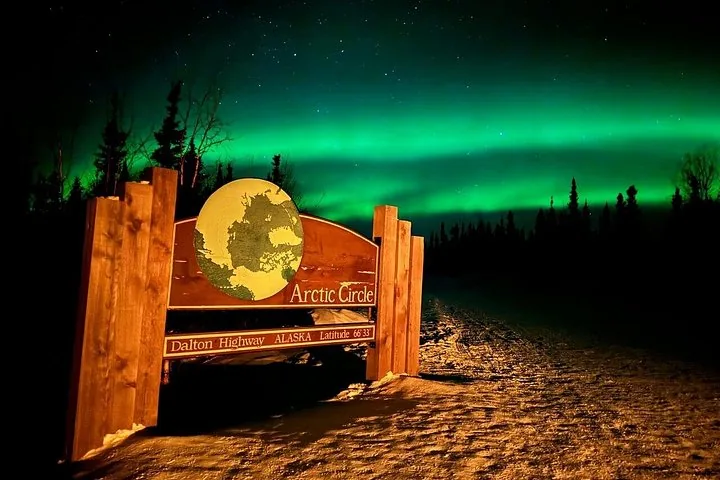
Northern Alaska has dark winter skies and a striking Arctic setting, but driving north does not guarantee an aurora. A sighting depends on darkness, cloud cover, solar activity and somewhere safe to wait.
A long guided Arctic Circle aurora tour suits you if you want both the historic road and a viewing session. If the lights are your only goal, a shorter aurora tour near Fairbanks gives you more chances over several nights with far less time on the road.
Not every viewing stop on an “Arctic Circle aurora” tour is north of the Arctic Circle. Some operators cross the Circle in daylight and watch for the aurora on the way back, closer to Fairbanks. The Northern Lights & Arctic Circle Tour (US$363, 12 to 14 hours, 4.6/5 from more than 1,000 reviews), for example, picks up in Fairbanks at 2:00 p.m. so the drive home runs through the dark hours. Read the exact itinerary before you book.
For a detailed comparison, read our Fairbanks northern lights guide and our month-by-month guide to the best time to see the northern lights in Alaska.
Best months for a Dalton Highway winter trip
Winter conditions can affect the Dalton for much of the year, so compare what each period is like for a visitor instead of treating any month as safe.
| Period | What to expect | Planning implication |
|---|---|---|
| Late August to September | Cooling weather, earlier darkness, possible early snow | A transition season; do not count on dry roads |
| October to November | Longer nights, colder weather, winter storms possible | Keep your travel dates flexible |
| December to January | Very short days and severe cold | Plan for long darkness and more exposure risk |
| February to March | Longer days, still deep-winter conditions | A popular time for winter scenery plus aurora |
| April | More light, variable snow and ice | Check each tour’s season end; the winter drives run to 21 April 2027 |
| May to June | Thaw, with winter-like spells still possible | Not reliably summer driving conditions |
For a winter sightseeing trip, March is a good month: you get more daylight than around the December solstice, and the nights are still dark enough for the aurora. That is a planning preference; March roads are not always safer, and the aurora is never guaranteed.
Our best time to visit guide covers the seasons month by month.
Winter self-drive vs guided tour: how to decide
| Consideration | Winter self-drive | Guided Arctic Circle tour |
|---|---|---|
| Vehicle | Must be equipped for the road and allowed on it by the rental contract | Vehicle and driver supplied |
| Road navigation | Your responsibility | Handled by the operator |
| Costs | Vehicle, fuel, equipment and money held back for problems | One per-person price up front; check what is excluded |
| Flexibility | High on paper, limited by safety and conditions | Fixed itinerary; can change for weather |
| Knowledge | You plan fuel, stops, communications and emergencies | Local guides who know the route |
| Aurora focus | You must find safe places to watch | Only if you book an aurora drive |
| Suitable for an inexperienced visitor | Not recommended | Usually the better choice, within operator policies |
If you have never driven a remote Arctic highway in winter, take a guided tour, or book aurora tours based in Fairbanks instead. A photo at the Arctic Circle sign is not worth making the drive the most dangerous part of your vacation.
Suggested winter itineraries from Fairbanks
One-day Arctic Circle trip
Set aside a full day and most of the night for a guided road tour. Do not book an early-morning departure or another activity right after the scheduled return. Bring warm layers, check what food is provided and expect the schedule to slip.
Two-day winter trip
Day 1: explore Fairbanks, learn about the area’s Arctic history and keep the evening easy. Day 2: take the guided Arctic Circle drive, then leave the next morning free to recover. If the northern lights come first for you, book the aurora drive and keep the following morning clear.
Three- or four-day aurora-focused stay
Spend several nights in Fairbanks to give yourself repeated chances at clear skies. Combine one Arctic Circle trip with a shorter aurora tour and a daytime outing such as Chena Hot Springs. Leave slack in the plan in case winter weather moves things around.
Our Alaska northern lights trip guide has longer sample itineraries.
Should you travel the Dalton Highway in winter?
Yes, if you pick the right trip and respect the conditions. The road is memorable for how remote it is: snow-covered forest, the Yukon River, Arctic landscapes and the crossing of the Arctic Circle itself.
It is still a working Arctic highway, not a tourist road. For a first winter visit, book a guided Arctic Circle winter drive. If the northern lights are a key goal, book an aurora drive, because a late return on a winter drive does not include a viewing session.
Next step: compare departures on our winter Arctic Circle tours page, or read how to visit the Arctic Circle from Fairbanks. Check your exact dates before you book, because winter schedules and road conditions change.
Frequently asked questions
Can you drive the Dalton Highway in December?
Yes, the road is open all year, but December conditions can be severe and the BLM does not advise independent travel between late October and early April. Check Alaska 511 and the forecast, confirm your vehicle is suitable, and consider a guided tour instead.
Is the Dalton Highway paved?
Partly. Most of it is gravel, with some paved sections. Even the paved stretches can be snowy or icy in winter, so do not expect ordinary highway driving.
Does the Dalton Highway close because of snow?
It does not close for the whole winter, but snow, drifts, avalanches and other hazards can bring temporary restrictions or closures. Conditions can change fast.
Can I drive a standard rental car on the Dalton Highway?
Many rental agreements prohibit the Dalton Highway or exclude damage there. Read the written contract and confirm it covers winter driving. An ordinary rental sedan is the wrong car for this road.
Can I visit the Arctic Circle sign during winter?
Yes, weather and road conditions permitting. Guided winter tours are planned around the Arctic Circle crossing and the sign stop, though operators can change the route for safety.
How far is the Arctic Circle from Fairbanks?
About 199 road miles, depending on where you start. The BLM plans on about five hours of driving each way in good conditions, and 5 to 7 hours with stops and bad weather.
Can you see the northern lights on a Dalton Highway tour?
Possibly, but only an aurora tour sets aside time to watch the sky. Even then, nobody can guarantee the lights.
Is the Dalton Highway dangerous in winter?
It can be. Extreme cold, blowing snow, few services and long distances make a vehicle problem far more serious than on a road near town. Prepare well and check conditions right before you go.
How cold is the Dalton Highway in winter?
It varies a lot by date and by section of road. The BLM says winter temperatures along the road are frequently 30°F below zero (about -34°C) and lower, with windchills to -70°F. Prepare for colder conditions than the Fairbanks forecast shows.
How long is a winter Arctic Circle tour?
The Arctic Circle Winter Drive Adventure takes about 16 hours, from a 9:45 a.m. departure to a return around 1 to 2 a.m. The Arctic Circle Aurora Drive Adventure takes 18 to 19 hours and gets back between 3:30 and 4:30 a.m. Check the current timetable before you book.
Should I visit Coldfoot or just the Arctic Circle sign?
The sign is a manageable goal for a long guided day trip. Coldfoot is farther north and makes more sense on an overnight or fly-drive trip if your schedule allows.
Is it better to visit in March or December?
In March there is usually more daylight for the scenery, and the evenings are still dark enough for the aurora. December is deep midwinter, with very long nights. Neither month guarantees good weather, clear roads or the northern lights.
Sources
Operator schedules and prices checked 19 November 2026. Check the weather and road access again right before you travel.
- Alaska Department of Transportation & Public Facilities, Dalton Highway overview: road length, surface, travel precautions, year-round maintenance and winter warnings.
- Alaska DOT&PF, Dalton Highway maintenance: 511 reports and maintenance updates.
- Bureau of Land Management, Arctic Interagency Visitor Center FAQs: seasons, ideal-condition drive times, winter services and temperatures.
- Bureau of Land Management, Dalton Highway visitor guide 2024: winter hazards, windchill and the advice against travel between late October and early April.
- Alaska 511 and its road-condition definitions: traveler warnings and what the reports can and cannot tell you.
- Northern Alaska Tour Company, Arctic Circle Winter Drive: seasonal schedule, price and the operator’s note that it is not an aurora tour.
- Northern Alaska Tour Company, Arctic Circle Aurora Drive: aurora-watching itinerary, timetable and prices.
- Northern Alaska Tour Company, Winter Fly-Drive: the Coldfoot overnight format and its prices.
Stand at 66°33′ North This Season
A day on the Dalton Highway, the Arctic Circle sign after dark and a watch for the aurora on the long drive home.
Check Availability & Book