Fairbanks Northern Lights Guide
Plan a Fairbanks northern lights trip: the 21 August to 21 April season, viewing spots, forecasts, and Fairbanks, Arctic Circle and Coldfoot aurora tours compared.
Fairbanks is one of the easiest places in Alaska to see the northern lights: it sits under the auroral oval, its nights are long and dark from 21 August to 21 April, and you can watch from town, from a hill road or from a heated lodge. Stay at least three nights, plan to be outside in the three or four hours around midnight, and pick your viewing night by the cloud forecast, not the calendar. September and March bring the equinox peaks; December to February give the longest nights and the hardest cold. No tour or place can promise a sighting.
Check Availability

Fairbanks also suits a first Alaska aurora trip because you can base yourself in town, spend one evening on a viewing tour and use a free day for something else, such as the Arctic Circle or Chena Hot Springs. This guide covers where to watch around Fairbanks, how a Fairbanks aurora tour compares with an Arctic Circle or Coldfoot trip, what each costs and what to do when the forecast changes. For the statewide picture, read our month-by-month northern lights guide and our guide to where to see the northern lights in Alaska; if you are still choosing a season, start with the best time to visit Alaska.
Why is Fairbanks so good for northern lights viewing?
Fairbanks lies beneath the auroral oval, the broad ring around the North Pole where the northern lights are most often overhead. Interior Alaska has a continental climate, and its skies clear more often than many coastal places. You also have choices: an open field near town, a darker hilltop, a heated aurora lodge, or a long trip north toward the Arctic.
You do not need to cross the Arctic Circle to see the northern lights. Strong displays fill the sky over Fairbanks itself. An Arctic Circle trip is a wilderness day out in its own right, and some versions add aurora watching on the drive back.
When is the best time to see the northern lights in Fairbanks?
The University of Alaska Fairbanks Geophysical Institute and Explore Fairbanks give a viewing season of 21 August to 21 April. Between late April and mid-August the nights are too light to see the aurora, even when it is active high above.
| Period | What to expect | Who it suits |
|---|---|---|
| Late August–September | Darkness returns; early-season viewing (aurora in August) and fall color; the September equinox is a strong aurora period | Travelers who want less severe cold |
| October–November | Longer nights each week; winter arrives | Flexible fall and winter travelers |
| December–February | Long nights, snowy landscapes and temperatures that can fall far below zero | Travelers who want a classic snowy Alaska trip |
| March | Dark evenings, longer days for sightseeing; the spring equinox is a strong period | Visitors pairing the aurora with daytime activities |
| Early–mid April | Aurora still possible while nights stay dark; daylight grows fast | Late-season visitors with flexible plans |
| Late April–mid August | Too much daylight for aurora viewing in Fairbanks | Midnight-sun and summer Arctic trips instead |
Is March better than December? Not automatically. March balances dark evenings with spring daylight and milder weather, while December gives you the longest nights. The Geophysical Institute puts the odds of aurora over Interior Alaska at roughly twice as high around the equinoxes as at the solstices, but cloud on your actual dates still matters most. For the full season-by-season comparison, read our best time to see the northern lights in Alaska guide.
What time at night should you go out?
The Geophysical Institute says the best time to watch is the three or four hours centered on midnight, roughly 10 p.m. to 2 a.m., and gives 9 p.m. to 3 a.m. as the wider window when big displays are most likely. A display can start earlier or run later. If the sky is clear and nothing is happening, stay out a little longer: the aurora can brighten within minutes, and one short burst may be the best of the night.
How many nights should you stay?
Plan at least three nights if seeing the aurora is a top priority. One night can be cloudy even when activity is strong. Explore Fairbanks says visitors who stay three nights and go out late have a better than 90 percent chance of a sighting; that is the tourism board’s estimate across many visitors, not a forecast for your dates. For an aurora-first holiday, four or five nights give you more room to wait for a clear sky.
Other Experiences
Other experiences you might enjoy
Arctic Circle trips from Fairbanks for another day of your stay, from summer day drives up the Dalton Highway to winter tours that watch for the aurora on the way back.

Best places to see the northern lights near Fairbanks
Pick a place for safe access, open sky, little artificial light and the weather that night. The highest point on the map is not always the best choice. The distances below are approximate road distances from Fairbanks given by Explore Fairbanks; the Coldfoot figure is the BLM’s mileage chart.
| Viewing location | Approximate distance | Main advantage | Important consideration |
|---|---|---|---|
| Creamer’s Field | 2 miles / 3 km | Open space close to town | More glow from the city than remote sites |
| Cleary Summit | 20 miles / 32 km | High, wide sky views and roadside pullouts | Sharp turns and winter driving |
| Murphy Dome | 25 miles / 40 km | High, open viewpoint | Snow, ice, steep grades and no services |
| Chena Lake Recreation Area | 17 miles / 27 km | Open lake and park setting near North Pole | Check park access and road conditions |
| Chena Hot Springs Road | Resort about 60 miles / 97 km out | Many darker viewing areas; resort at the end of the road | Patchy phone signal and moose on the road |
| Coldfoot | 259 miles / 417 km | A deep Arctic road trip and dark skies | An overnight or guided trip from Fairbanks |
1. Creamer’s Field: best easy-access option
This open wildlife refuge is close to town and works for a first attempt. Use it when the forecast looks good and there is no time to arrange a tour. Check public access and conditions, stay in permitted areas and expect some glow from the city.
2. Cleary Summit: best familiar elevated viewpoint
Cleary Summit has wide views and established roadside pullouts. It is popular, so arrive carefully and park well off the road. In snow and ice you need a suitable vehicle, current road information and winter driving experience. Never stop in the travel lane.
3. Murphy Dome: best expansive hilltop views
Murphy Dome gives a wide-open panorama and good foregrounds for photos. The climb, the turns and the road surface make it a poor last-minute choice in winter for a driver new to ice. A local guide is the sensible alternative.
4. Chena Lake Recreation Area: best open landscape near North Pole
This recreation area near the town of North Pole has room to see the whole sky and, before freeze-up, reflections on the water. In winter, use maintained access routes, and never assume lake ice is safe because the weather is cold.
5. Chena Hot Springs Road: best flexible dark-sky corridor
Chena Hot Springs Road leads away from the town lights toward Chena River State Recreation Area and the resort. There are many possible viewpoints, but not every informal pullout is safe or open. Phone coverage is patchy, and moose on the road are a real risk at night. Check access before you set off.
6. Coldfoot: best for a more remote Arctic adventure
Coldfoot sits at milepost 175 of the Dalton Highway, far north of Fairbanks. It suits you if crossing the Arctic Circle, seeing the Brooks Range and staying in remote Alaska matter as much as the aurora. Do not assume the remoteness guarantees a better display: what you see still depends on clouds and solar activity. For most visitors, a specialist tour is safer than a winter self-drive; our multi-day tours page covers the overnight trips that stay at Coldfoot.
Read next: Arctic Circle tours from Fairbanks and Fairbanks to the Arctic Circle: route and distance.
Best types of Fairbanks northern lights tours
These are different products for different travelers. Compare the actual itinerary and the operator’s weather and cancellation terms before booking.
| Tour type | Best for | What to check | Example on Viator |
|---|---|---|---|
| Fixed-location aurora lodge | A warm place to wait and a relaxed evening | Heated cabin, time spent outdoors, transport | Aurora Husky Lodge, $136, 4.6/5 from 300+ reviews |
| Aurora-chasing road tour | Travelers who want the guide to move with the clouds | Whether the route changes with the forecast, total length, photo help | Aurora Chaser Tour, $161, 4.5/5 from 28 reviews |
| Photography-led tour | Help with aurora photos and portraits | Whether edited images and gear advice are included | Electric Moose Studios Aurora Adventure, $308, 5.0/5 from 240+ reviews |
| Arctic Circle and aurora road tour | Big sightseeing plus night-sky watching | A very long day, the stops, return time, season | Northern Lights & Arctic Circle Tour, $363, 4.6/5 from 990+ reviews |
| Coldfoot or Arctic fly-drive trip | Several days in the Arctic | Flight weather plans, lodging, whether night viewing is built in | Booked with the operator; see our fly-drive page |
Fairbanks vs Arctic Circle vs Coldfoot aurora trips
The bigger choice is how far north you go. A Fairbanks tour is one evening of sky watching; an Arctic Circle aurora tour is a long road trip with the night search on the way back; a Coldfoot trip is two or more nights in the Brooks Range foothills, 259 road miles north of Fairbanks.
| Fairbanks-area aurora tour | Arctic Circle and northern lights tour | Coldfoot overnight aurora trip | |
|---|---|---|---|
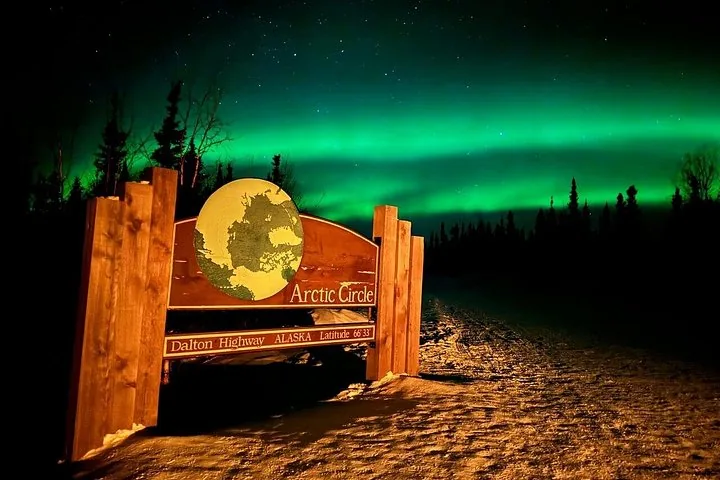
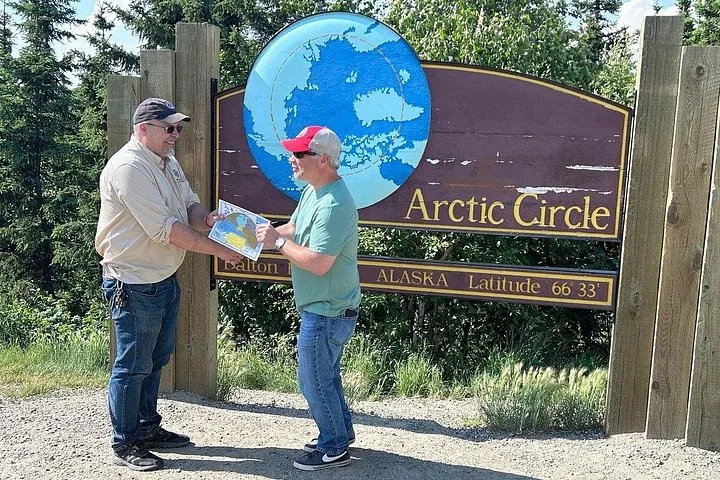
| What you do | Watch the sky from a lodge, a ridge or several viewpoints | Drive the Dalton Highway to the Arctic Circle sign at milepost 115, then look for the aurora on the return | Stay in the Arctic with more than one night to watch |
| How long | Usually 4 to 6 hours | 12 to 14 hours on the Northern Lights & Arctic Circle Tour, 18 to 19 hours on the Aurora Drive | Usually 3 days and 2 nights |
| Transport | Van or minibus from your hotel | A long road day; fly-drive versions fly one way | Road, small plane or both |
| Comfort | Heated lodges or warming shelters on many tours | Long hours seated in the vehicle, with roadside stops | Remote lodging with basic services |
| Best for | Most first-time aurora visitors | Travelers who want to cross the Arctic Circle | Travelers who want days in the Arctic, not one evening |
| Main trade-off | No Arctic Circle crossing | Fatigue, gravel road and a return after midnight | More time, more cost and flights that depend on weather |
| Example | Northern Lights Tour with Free Photos, from $225, 4.8/5 from 290+ reviews | Northern Lights & Arctic Circle Tour, $363, 4.6/5 from 990+ reviews | Booked with Northern Alaska Tour Company directly |
| Aurora guaranteed? | No | No | No |
Durations and inclusions vary by operator and departure, so read the listing for your date.
Bookable examples to compare
These are live listings checked in November 2026, not a quality ranking, and no operator can promise the aurora. Prices, dates, pickup areas, inclusions and availability can change.
Aurora chase with photos: the Northern Lights Tour with Free Photos - Arctic Night Tours on GetYourGuide (from $225, 4.8/5 from 290+ reviews). The guide collects you from your hotel, picks the route on the night to find a clear sky and takes your photos. You can cancel up to 24 hours ahead for a full refund, which helps when the cloud forecast turns.
Small-group chase from downtown: the Northern Lights (Aurora Borealis Viewing) Chasing with Photography in Fairbanks by Alaska Journey Tours ($189, 4.8/5 from 540+ reviews). About four hours, with pickup from listed downtown hotels and the guide’s photos sent as JPG files about three days later. Choose it if you want pictures without carrying a camera kit.
Lodge with big windows: the Northern Lights Lodge Viewing in Fairbanks by 1st Alaska Outdoor School ($160, 4.4/5 from 120+ reviews). Five hours at a heated lodge outside town, with pickup from selected hotels. Viator currently shows dates from 21 August to 10 October 2027 only, and all sales are final.
Chase with a campfire: SkyChase, Northern Lights Experience by Aurora In Alaska ($335, 4.8/5 from 810+ reviews). About five hours; the guides choose the site each night from forecast models, then serve hot drinks and a campfire meal while you wait, and the photos are included. Its “aurora guarantee” applies only on nights it labels guaranteed: if nobody sees the aurora, you choose a 50 percent refund or another night. That is a refund rule, not a promise of lights.
Aurora lodge: Aurora Viewing - Aurora Husky Lodge , Great view from top of the ridge ($136, 4.6/5 from 300+ reviews). An evening of about five hours at a cabin on a ridge roughly 40 minutes’ drive from Fairbanks, with pickup from your hotel and hot cocoa, coffee, tea and snacks inside between looks at the sky. Photos of you under the aurora cost extra. It suits travelers who want one place with somewhere warm to retreat to, and the listing offers free cancellation.
Aurora chase: the Aurora Chaser Tour by Auroraquest ($161, 4.5/5 from 28 reviews, a small sample). A small-group night drive of five to six hours that moves between viewpoints, led by guides who co-own the business; every vehicle carries a spare tripod. All sales are final, so book it only once your dates are fixed.
Photography night: the Electric Moose Studios Aurora Adventure W/Portraits & Hot Pizza!! ($308, 5.0/5 from 240+ reviews). A six-hour small-group outing run by a portrait photographer, with a heated warming shelter, hand and toe warmers, headlamps and snacks. A digital album of landscapes and portraits and a whole-night timelapse are included. If you get no aurora photos, the operator offers another night free, subject to seats.
Arctic Circle and northern lights: the Northern Lights and Arctic Circle Trip from Fairbanks by 1st Alaska Outdoor School ($330, 4.6/5 from 180+ reviews). The 14-hour itinerary covers the Dalton Highway, the Yukon River and the Arctic Circle sign, leaving in the afternoon and getting back late. You may see the aurora on the drive back, but nobody can promise it.
Shared Arctic Circle and aurora trip: the 1 Day Shared Tour Arctic Circle and Aurora Viewing in Alaska by Alaska Safari Sultan Tours ($329, 4.5/5 from 78 reviews). About 12.5 hours past the Yukon River Bridge and up the Dalton Highway to the Arctic Circle monument, with the guide’s aurora photos included. Check which option you select: the aurora-only option does not go to the Arctic Circle.
The longest road version: Northern Alaska Tour Company’s Arctic Circle Aurora Drive Adventure ($369 on Viator, 4.6/5 from 30+ reviews; the operator’s own 2026–27 fares are $359 standard and $399 peak). It leaves Fairbanks at 9:45 a.m. and gets back around 3:30 to 4:30 a.m., after the Yukon River, the Arctic Circle crossing and aurora stops on the drive south. Meals are not included.
Fly one way: the same operator’s Arctic Circle Aurora Fly/Drive Adventure (southbound) flies you north at 1:00 p.m. and drives you back down the Dalton through the night, from $639 standard and $679 peak for 2026–27. It is booked with the operator only, and the flight depends on the weather.
Coldfoot overnight: Northern Alaska Tour Company’s Arctic Circle Aurora Overnight Adventures stay at Coldfoot Camp, with three-day, two-night packages for 2026–27 and optional trips to Wiseman. They are sold only by the operator, not on Viator or GetYourGuide, and the small-plane legs can be held up by weather, so leave a spare day before your flight home. Our Coldfoot page covers the settlement.
See also: Which Arctic Circle tour should you book? and our northern lights tours page.
Should you book an aurora tour or go independently?
Go on your own if you have a suitable vehicle, are comfortable driving on winter roads and can pick a safe, permitted viewpoint. You can then wait for the clearest evening and go out at short notice.
Book a tour if you do not want to drive after midnight, are new to cold-weather travel in Alaska, or want a guide to handle the logistics and the photos. Some operators watch the clouds and move; others take everyone to one fixed spot. Neither approach wins every night.
If you are also thinking about an Arctic Circle trip, remember that a combined day means many hours in a vehicle. A short aurora outing near town plus a separate daytime Arctic Circle tour can be more comfortable; our guide to whether the combined tour is worth it sets out the trade-offs.
Which tour gives you the best chance of seeing the aurora?
Nobody can rank tours by sighting odds from their destination or their marketing. Five things shape your night instead:
- Darkness: from late April to mid-August the Fairbanks sky is too bright for useful viewing.
- Cloud: a strong aurora behind thick cloud can be invisible.
- Aurora activity: displays vary from night to night, and forecasts give probabilities.
- The horizon and stray light: an open, dark site helps most with a weak display.
- The number of tries: three nights out give you three chances; one night gives you one.
The Geophysical Institute notes that the weeks around the March and September equinoxes tend to be more active. Treat that as a seasonal pattern, not a promise for your dates.
Does driving north to the Arctic Circle improve your chances?
Not by itself. Fairbanks already sits under the auroral oval, so on most nights the cloud forecast and the route matter more than the extra miles. Book an Arctic Circle tour for the Dalton Highway, the Yukon River and the crossing, and count the aurora as a possible extra on the drive back.
Which months suit each type of tour
| Travel period | Fairbanks aurora tour | Arctic Circle and aurora tour | Why |
|---|---|---|---|
| Late August–September | A good fit | Some seasonal departures | Dark nights return and early-season weather is mild |
| October–November | A good fit | Good where tours run | Longer nights, colder roads each week |
| December–January | A strong winter choice | Only if you are ready for a long, very cold day | Long darkness, severe cold, little daylight |
| February–March | A strong winter choice | A good month for winter scenery | Dark evenings, more daylight for sightseeing, the March equinox |
| Early–mid April | Possible while nights stay dark | Departures vary | Lengthening days shorten the viewing window |
| Late April–mid August | Not for the aurora | Book a daytime summer Arctic Circle tour instead | Summer twilight and daylight hide the aurora |
Choose a tour by your travel style
You have one evening
Book a Fairbanks aurora tour. You keep the day free and skip the all-day commitment of the Arctic Circle. Pick a heated lodge if you feel the cold, or a chase if you care more about photos and moving with the clouds.
You have two or three nights
Take a Fairbanks aurora outing on one of the first nights. If you also want to cross the Arctic Circle, book a daytime Arctic Circle tour, or a combined one on a date with a free morning after it. Keep another night open for a second try.
Crossing the Arctic Circle is on your list
Book an Arctic Circle drive or fly-drive and accept the long schedule. The crossing, the remote road and the Arctic landscape still make the day if the sky stays cloudy. Our guide to which Arctic Circle tour to book compares the day, night and fly-drive versions.
You want good photos of yourself under the aurora
Compare what each photo tour delivers: portraits or only landscapes, edited or straight files, how they reach you, and what happens on a night without aurora. A dedicated photo tour such as the Electric Moose Studios night or the Alaska Journey Tours chase suits this better than a full Arctic Circle day.
You travel with children or older relatives
Look at the length, toilet stops, seating, warm shelter, age limits and return time. A heated-lodge evening is easier than an Arctic Circle day that ends after midnight. Some tours set a minimum age (five on the 1st Alaska Outdoor School Arctic Circle trip), so check the listing before you pay.
You visit in summer
Book a daytime Arctic Circle tour for the Dalton Highway and the midnight sun. Do not book a northern lights tour for June or July: the sky stays too bright to see the aurora. Late August is the exception, and our guide to northern lights in Alaska in August explains when the season opens.
What northern lights tours cost and what to compare
Ticket prices alone can mislead, because the formats include very different things. In November 2026 the Fairbanks aurora tours above run from $136 to $335 per person, and the Arctic Circle and aurora tours from $329 to $369. Northern Alaska Tour Company’s own 2026–27 fares show the spread on one operator: $159 for the Homestead Aurora Adventure, an evening of sky watching north of Fairbanks, against $359 standard or $399 peak for the Arctic Circle Aurora Drive, which adds a full day on the Dalton Highway.
Before you compare two prices, check what each one includes:
- Hotel pickup, and which hotels or areas the pickup covers
- Time actually spent watching, not just the total length
- A heated building or warming shelter
- Photos, and how they are delivered
- Loaned winter clothing or boots
- Food and hot drinks
- Tips, taxes and extra fees
- What happens if the lights do not appear: refund, another night, or nothing
“Aurora guarantee”, “free cancellation”, “retry policy” and “no refund if no lights” are four different terms, so read the wording in full. The same tour can also cost a different amount on Viator, on GetYourGuide and with the operator, and some operator packages, such as the Coldfoot overnights, are not sold on either platform.
How to read the Fairbanks aurora forecast
A simple routine works better than chasing a single number in an app:
- Check darkness: the Fairbanks aurora season runs from 21 August to 21 April.
- Check the local clouds: a moderate aurora under a clear sky is easier to see than a strong one behind cloud.
- Check the University of Alaska Fairbanks Geophysical Institute forecast: it describes aurora activity and says nothing about cloud over your viewpoint.
- Use the Explore Fairbanks Aurora Tracker: it puts aurora activity, local weather and daylight for places around the region on one screen.
- Check again before you leave: forecasts change, and one poor forecast does not mean the night is lost.
Useful tools: UAF Geophysical Institute aurora forecast · Explore Fairbanks Aurora Tracker.
Does a full moon ruin aurora viewing?
No. Moonlight hides faint aurora and stars and lowers the contrast in photos, but a bright display still looks impressive under a full moon. Darker moon phases matter most to photographers chasing subtle colors and foreground detail.
What to wear for Fairbanks northern lights viewing
You will be outside late at night, standing still. Winter cold here can be dangerous, and September and January feel very different, so dress for the forecast on the night.
- A base layer that moves moisture away from your skin, and insulating mid-layers.
- A warm, windproof outer layer; insulated pants in deep winter.
- Insulated boots with room for thick socks.
- A hat, a neck gaiter and insulated mittens, which are usually warmer than gloves.
- Hand and foot warmers and a thermos, if you want them.
- A headlamp, ideally with a dim red setting that protects your night vision.
- A charged phone and a backup battery, both kept in an inside pocket.
On a self-drive, carry cold-weather emergency supplies and tell someone where you are going. Skip unlit roadside stops where you cannot pull fully clear of traffic. In deep cold, a heated lodge or a guided trip is far more comfortable than hours of waiting outside. Our what to wear guide covers layers for the Arctic Circle drive too.
How to photograph the northern lights in Fairbanks
You do not need professional gear to bring home a memory, though results depend on how bright the aurora is and on your device.
On a smartphone: use night mode if it has one, keep the phone completely still on a small tripod or a steady surface, and turn the flash off. Do not overexpose the shot into a pale green blur; on a strong display, a shorter exposure keeps the shape of the moving curtains.
On a camera: a sturdy tripod, a wide-angle lens, manual focus on the stars and a wide aperture are good starting points. Adjust ISO and shutter speed to the conditions, since long exposures blur fast-moving aurora. Keep spare batteries in an inside pocket in sub-zero weather.
If photos are a top priority, pick a tour that lists composition help or portraits, such as the Electric Moose Studios night above, because not every aurora guide takes pictures.
A realistic 3-night Fairbanks northern lights itinerary
Day 1: Arrive and try an easy local viewing location
Check the forecasts, collect warm clothing and rest after the flight. If the sky is clear and you feel up to it, try a nearby spot such as Creamer’s Field or a short guided evening. Do not drive tired after a long flight. Our page on where to stay in Fairbanks covers the areas that tour pickups serve, and our guide to hotels, cabins and aurora lodges covers rooms where you can watch the sky yourself.
Day 2: Arctic Circle or other daytime excursion, with aurora backup
Take an Arctic Circle drive if the road trip itself appeals to you. Some combined itineraries run into the early morning, so do not book another late tour the next night. For a shorter day, see the Fairbanks sights or Chena Hot Springs and keep the evening free.
Day 3: Your main aurora tour
Choose a lodge or a chase depending on the weather and how you feel. A clear evening at a safe viewpoint near town can beat a long drive under poor skies. Photograph the aurora if it appears, but leave time just to watch it.
If the aurora is the reason for your trip, keep all three nights flexible. Swap your main viewing night to the clearest forecast instead of sticking to a fixed plan.
With only two nights
Take a lodge or chase tour on the first night if you arrive in time, see the town by day and rest in the afternoon, then go out again on the second night. Do not book an early departure for the morning after a tour that ends in the middle of the night.
With four or five nights
Use Fairbanks as a base for two aurora nights, one guided Arctic Circle tour and a day at Chena Hot Springs or the town’s museums. For a remote Arctic stay, swap the Arctic Circle day for a Coldfoot overnight, and keep a spare day in case weather delays the small-plane flights. Our Alaska northern lights trip planner has longer itineraries.
Is an Arctic Circle tour from Fairbanks worth adding?
Yes, if you want the Arctic scenery and the crossing as well as a chance of the aurora. You still get the Arctic Circle sign, the Yukon River and the Dalton Highway if the lights never appear. You do not have to reach the Arctic Circle for a strong display, though, and driving farther north does not clear a fully overcast sky.
| Choose a Fairbanks-only aurora tour if… | Choose an Arctic Circle combination if… |
|---|---|
| Your priority is time spent watching the sky | You want a major Alaska road trip and the Arctic Circle crossing |
| You prefer a shorter outing | You are fine with a long day and a late return |
| You want a lodge or a photography-led night | You want scenery, roadside stops and a chance of aurora |
| You have limited energy or mobility | You are comfortable on a rough, remote road |
Read our guide Is an Arctic Circle tour from Fairbanks worth it?
Frequently asked questions
Can you see the northern lights in Fairbanks itself?
Yes. Fairbanks sits beneath the auroral oval, and displays are visible from town, especially when activity is strong. For fainter displays, a darker spot with an open view works better.
Which month is best for Fairbanks northern lights?
September and March are popular because of the equinox periods and milder travel conditions. December to February suit travelers who want the longest darkness and deep-winter scenery. A clear sky on your actual night matters more than the month.
What are the best hours to see northern lights in Fairbanks?
The three or four hours around midnight, roughly 10 p.m. to 2 a.m., with 9 p.m. to 3 a.m. as the wider window. The lights can appear outside these hours, so allow several hours and keep checking the sky.
Can you see the northern lights in Fairbanks in July?
Not in practice. Summer twilight and daylight make the aurora invisible, even when it is active above the Earth.
Do you need a tour to see the northern lights in Fairbanks?
No. Spots near town can work well, but a guided trip takes away the winter driving and can add a heated place to wait, photo help or a route that follows the clear sky.
Are the northern lights guaranteed on a tour?
No. Seeing the aurora depends on solar activity, darkness, clouds and timing. Read the cancellation terms: many tours run even when no lights appear, and most do not refund for a missed sighting. A few, such as Electric Moose Studios, offer a repeat night if you get no aurora photos.
Is Fairbanks or Coldfoot better for northern lights?
Fairbanks is easier for most visitors because it has the hotels, transport and tours. Coldfoot gives you a remote Arctic trip, but clouds can still hide the sky there. Go to Coldfoot for reasons beyond the aurora.
What is the best northern lights tour in Alaska?
For most first-time visitors, a guided evening tour from Fairbanks is the easiest choice. Pick a heated lodge for comfort, a chase for flexibility and photos, or an Arctic Circle combination if crossing the Arctic Circle matters to you as much as the aurora.
Is Fairbanks or the Arctic Circle better for northern lights?
Neither guarantees a display. Fairbanks already sits under the auroral oval, and the cloud on your night matters more than crossing the line. The Arctic Circle adds a remote road trip, which is the reason to go.
Is an Arctic Circle northern lights tour worth it?
Yes, if you want the Dalton Highway, the Yukon River and the crossing whether or not the aurora appears. If you only want the northern lights, a Fairbanks tour gives you more watching time for fewer hours and less money.
How long are Fairbanks aurora tours?
Most run four to six hours, starting in the evening and returning after midnight. Check the departure and return times on the listing.
How long is an Arctic Circle northern lights tour?
From about 12 to 19 hours, depending on the tour. The Northern Lights & Arctic Circle Tour runs 12 to 14 hours; Northern Alaska Tour Company’s Arctic Circle Aurora Drive leaves at 9:45 a.m. and returns around 3:30 to 4:30 a.m.
Are northern lights tours good for families?
Some are, especially shorter tours with a heated place to wait. Check the minimum age, the time outdoors, the return time and toilet stops; some Arctic Circle tours do not take younger children.
Should I book two northern lights tours?
If seeing the aurora is a main goal and your budget allows, two nights out give you two chances. Compare the cancellation terms first, so you are not locked into a night with a poor cloud forecast.
Should I book on Viator, GetYourGuide or with the operator?
Compare the same tour, date, inclusions and terms on each channel, because prices and availability can differ. Some operator packages, including the Coldfoot overnight trips, are sold only by the operator.
How long should I stay in Fairbanks for northern lights?
Three nights is a useful minimum, and four or five nights are better for an aurora-first holiday. More nights give you more chances but cannot remove the uncertainty.
Can I combine Chena Hot Springs and aurora viewing?
Yes. The road and the resort are popular for both soaking and aurora watching, and the Northern Lights & Chena Hot Springs Tour on GetYourGuide (4.5/5 from 170+ reviews, about 10 hours) combines them. Check what your ticket covers: a pool pass does not always include transport or aurora viewing.
Do I need a high Kp index to see the aurora from Fairbanks?
Not necessarily. Fairbanks is so far north that the aurora can appear with fairly modest activity. A clear sky and distance from bright lights still matter.
Bottom line
Fairbanks is one of the most practical bases in Alaska for a northern lights trip. Go between 21 August and 21 April, stay at least three nights, and choose your main viewing night by the cloud forecast. Pick a lodge, a chase or a safe viewpoint near town for that night. Add an Arctic Circle tour if the Dalton Highway and the crossing appeal to you whether or not the aurora appears.
Next steps: compare Arctic Circle tours from Fairbanks · read the Alaska aurora season guide · compare northern lights destinations. Check your exact dates on the listing, because winter schedules can change.
Sources
- University of Alaska Fairbanks Geophysical Institute: aurora forecast and FAQs: season, viewing hours around midnight, the equinox effect, clouds and multi-night planning.
- Explore Fairbanks: aurora season: the Fairbanks season, the auroral oval and three-night odds.
- Explore Fairbanks: aurora viewing locations: named viewpoints, distances and winter road cautions.
- Explore Fairbanks: Aurora Tracker: forecast tool combining sky, weather and daylight.
- Travel Alaska: how to see Alaska’s northern lights: statewide viewing advice.
- Northern Alaska Tour Company: Arctic Circle Aurora Drive Adventure: 2026–27 fares, departure and return times.
- Northern Alaska Tour Company: Homestead Aurora Adventure: 2026–27 fare for the evening tour.
- Northern Alaska Tour Company: Arctic Circle Aurora Overnight Adventures: Coldfoot packages for 2026–27.
Stand at 66°33′ North This Season
A day on the Dalton Highway, the Arctic Circle sign after dark and a watch for the aurora on the long drive home.
Check Availability & Book