Arctic Circle Alaska: How to Visit from Fairbanks
How to visit the Arctic Circle in Alaska from Fairbanks: where the sign is, guided drives, fly-drives and self-driving, seasons, aurora odds, what to pack and FAQs.
Most visitors reach the Arctic Circle in Alaska on a guided day tour from Fairbanks. The sign stands at milepost 115 of the Dalton Highway, about 200 road miles (320 km) north of the city, and the BLM plans on about five hours of driving each way in good conditions, or five to seven once you count stops, road work and weather. A guided drive takes 12 to 19 hours door to door. The other two ways in are a fly-drive with Northern Alaska Tour Company, which adds Coldfoot and a small-plane flight, or driving yourself in a vehicle whose rental contract allows the Dalton. In aurora season the Northern Lights & Arctic Circle Tour ($363, 4.6/5 from 990+ reviews) is the one most first-timers book; check your dates below.
Check Availability
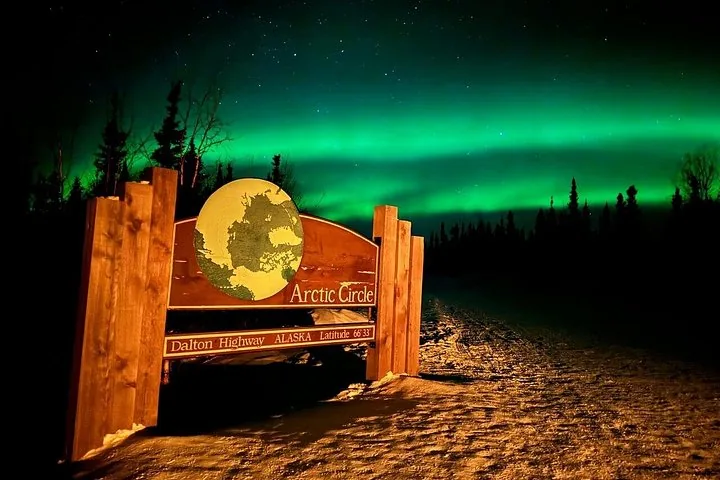
Northern Lights & Arctic Circle Tour
- 4.6/5 (990+ reviews)
- 12 to 14 hours
- Operated by Alaska Wild Lights
Includes Driver-guide from Alaska Wild Lights · Hotel pickup and drop-off within Fairbanks city limits · Personalized Arctic …
You'll choose your date and complete the booking on Viator.

Arctic Circle Alaska at a glance
You do not need to go to Deadhorse, Prudhoe Bay or the Arctic Ocean to cross the Arctic Circle. Reaching the sign on the Dalton Highway puts you over the line, and the road there, through boreal forest, along the pipeline and over the Yukon River, takes up most of the day.
| Question | Answer |
|---|---|
| Where is the Arctic Circle sign? | The BLM Arctic Circle Wayside, Dalton Highway milepost 115 |
| How far is it from Fairbanks? | About 200 road miles each way; the BLM mileage chart gives 199 |
| How long is the drive? | About 5 hours each way in good conditions, 5 to 7 with stops and weather (BLM); guided trips take 12 to 19 hours in all |
| Can you go on a guided tour? | Yes, all year; which tours run depends on the season |
| Can you drive yourself? | Yes, in a suitable vehicle whose rental terms allow the Dalton, with remote-road experience |
| Can you fly? | Yes; Northern Alaska Tour Company flies between Fairbanks and Coldfoot, booked direct |
| Is there a ticket for the sign? | No; the wayside has no entrance fee |
| Are the northern lights guaranteed? | No; you need darkness, aurora activity and a clear sky |
| Is there phone signal at the sign? | No, according to the BLM |
Where the Arctic Circle is in Alaska
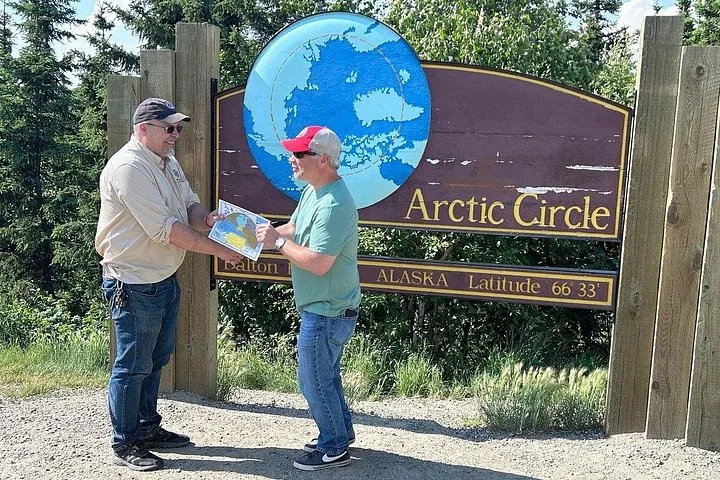
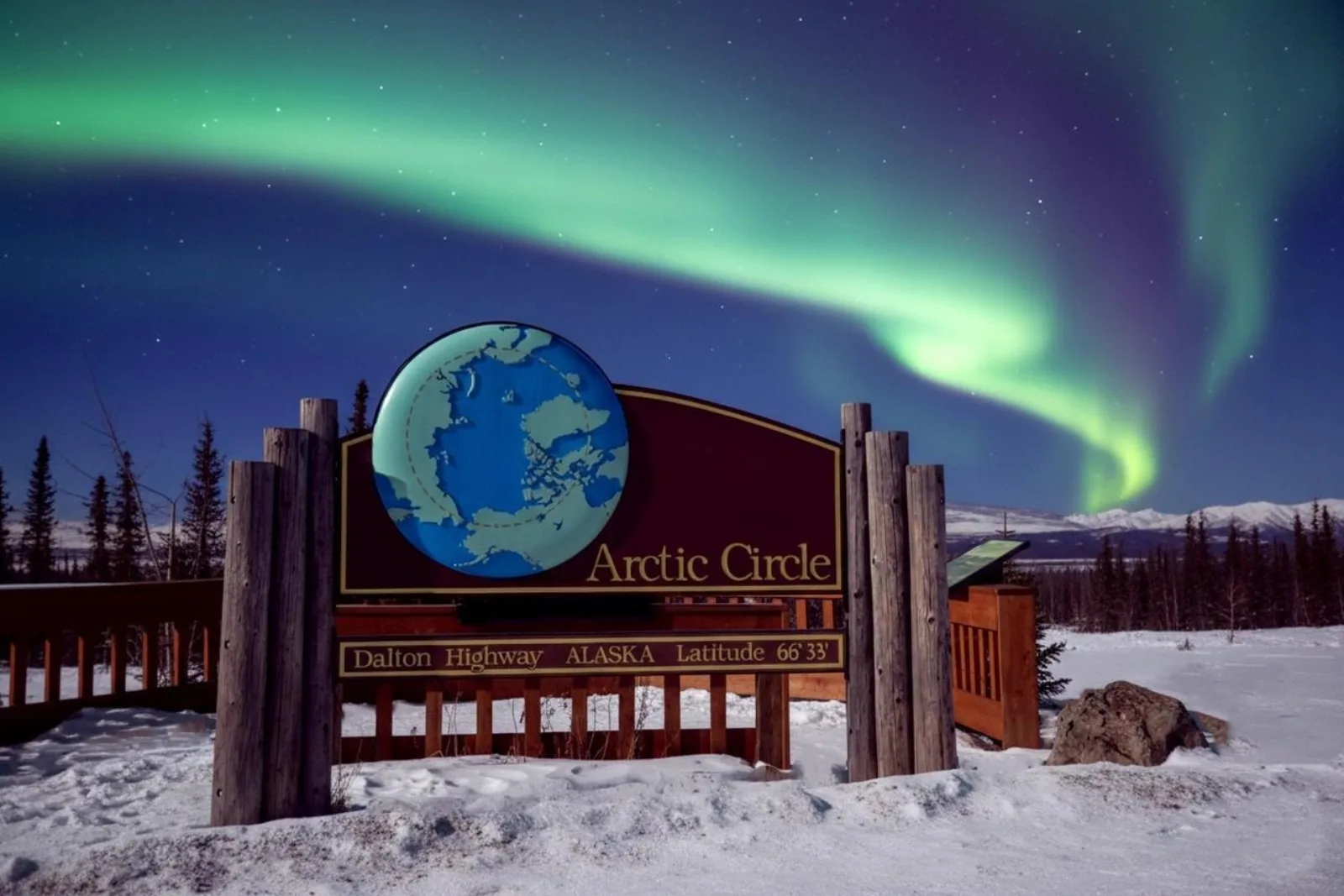
The Arctic Circle is the line of latitude at about 66°33′ north, the southern edge of the zone that gets at least one day of midnight sun and one of polar night each year. In Alaska the road crossing is the BLM Arctic Circle Wayside beside the Dalton Highway. Three places get mixed up:
- Arctic Circle Wayside: the roadside pull-off with the Arctic Circle sign, an observation deck, interpretive panels and pit toilets.
- Arctic Circle Campground: about half a mile up the hill from the wayside, a separate seasonal campground, not the photo stop.
- Coldfoot: a truck stop and camp about 60 Dalton Highway miles farther north, used for overnight and fly-drive trips. It is not the sign. Our Coldfoot page covers it.
The BLM lists the wayside at 66.555833, -150.810833. It has parking but no cell coverage.
How to get to the Arctic Circle from Fairbanks
The route is short to describe:
- Leave Fairbanks north on the Steese Highway.
- At Fox, turn onto the paved Elliott Highway.
- Near Livengood, 84 miles from Fairbanks, join the Dalton Highway (Alaska Route 11), where the gravel begins.
- Drive north over the Yukon River and past Finger Mountain to the wayside at Dalton milepost 115.
Dalton mileposts count from the highway’s own start near Livengood, not from Fairbanks, so milepost 115 is about 200 miles from the city. Our Fairbanks to Arctic Circle guide breaks the drive down mile by mile, and the Dalton Highway guide covers the road itself, its mileposts and how to prepare.
Other Experiences
Other experiences you might enjoy
More ways to reach the Arctic Circle from Fairbanks, from summer day drives up the Dalton Highway to winter aurora tours past the Yukon River.

Three ways to visit the Arctic Circle
1. A guided drive from Fairbanks
For a first visit this is the easy choice. The guide drives the gravel, stops at the viewpoints and explains the country, and you need no Dalton-approved vehicle. In summer you book a daylight sightseeing drive; between late August and April you can book one that waits up for the aurora on the way back.
Most drives stop at the Trans-Alaska Pipeline, the Yukon River crossing, Finger Mountain when conditions allow and the Arctic Circle sign. Weather, seasonal closures and road work can change the stops on the day.
The trade-off is a long day in a vehicle on a rough road, with little room for extra photo or rest stops. Read the listing for meals, hotel pickup, age limits and the cancellation policy before you book.
Three drives cover most dates:
- The Arctic Circle Day Tour ($335, 4.7/5 from 730+ reviews) by Alaska Wild Lights runs about 13 hours in a small group with Fairbanks hotel pickup, stopping at the pipeline, Finger Mountain and the sign. It runs from 3 May to 21 August 2027.
- Northern Alaska Tour Company’s Original Arctic Circle Drive ($289 on Viator, 4.8/5 from 220+ reviews) takes about 16 hours and checks in at the company’s airport office rather than collecting you. On Viator it runs from 21 August to 18 September 2027.
- In winter the same company runs the Arctic Circle Winter Drive Adventure ($309, 4.9/5 from 160+ reviews), also about 16 hours from the airport office.
Book against your exact date and departure point, and do not assume a meal or a hotel transfer is included. Our guide to choosing an Arctic Circle tour sets the drives against each other by season, budget, group size and refund terms.
2. A fly-drive or Arctic flight
Fly-drives come in different shapes. Some fly north to Coldfoot and drive you back down the Dalton; others drive north, stay the night at Coldfoot Camp and fly back to Fairbanks. A flight shows you more of the Arctic than the roadside sign, and some trips add a night of aurora viewing farther north. Every one we know of is sold only by Northern Alaska Tour Company on its own site, not on Viator or GetYourGuide, so we have no booking link for them. They cost more than a drive, and the flights depend on the weather.
Three winter examples, with the operator’s prices checked on 30 October 2026:
- Winter Fly/Drive Southbound: fly north at 1:00 p.m., ride back by road, home about 1:00 to 2:00 a.m. on Sundays, Tuesdays and Fridays, $579 or $619 on peak dates.
- Aurora Fly Drive Northbound: drive north on day one, sleep at Coldfoot Camp with an evening aurora trip to Wiseman, and fly back on day two, from $739 to $999 per person by date, sharing a room.
- Winter Air Adventure: a flight of about four hours, leaving at 1:00 p.m., from $649 ($689 in March 2027). You cross the Circle by air and do not stand at the sign.
Our fly-drive page lists every fly-drive and flight with its season and return time, and the multi-day page covers the Coldfoot overnights. Schedules change each season, so check the operator’s page for your dates.
3. Driving yourself
You can drive yourself, but this is not a day out to a national park. The Dalton is a truck route with steep grades, long gravel stretches, potholes, dust or mud, sudden weather and very few services. Explore Fairbanks warns that most standard rental vehicles are not allowed on it, so an ordinary SUV booking is not enough unless the written rental terms say the Dalton is allowed.
Before you set out:
- Get written permission from the rental company, or take a capable vehicle of your own.
- Check Alaska 511 for incidents, weather and road work.
- Carry a full-size spare, repair kit, first-aid kit, warm clothing, food and extra water.
- Plan fuel stops: the Yukon River crossing and Coldfoot sell fuel, and opening hours vary.
- Download offline maps, because there is no cell coverage over most of the route.
- Allow far more time than a navigation app suggests, and be ready to turn back.
- In winter, take a guided trip unless you have real experience on ice and remote Alaska roads.
If the photo at the sign is the goal, a guided tour is usually less work. Our self-drive vs tour guide compares the costs and the rental rules.
What you see on the way
The drive is much of the reason to go. Depending on the tour and the season, the stops can include:
| Stop | What it is | Dalton milepost |
|---|---|---|
| Trans-Alaska Pipeline viewpoints | The pipeline that the highway was built to serve | Several, including south of the Dalton |
| Start of the Dalton Highway | Where the pavement ends near Livengood | 0 |
| Yukon River crossing | The bridge over Alaska’s longest river, with a camp, fuel and a rest stop | 56 |
| Finger Mountain | A granite tor on open tundra with a short trail in summer | 98 |
| Arctic Circle Wayside | The sign, a deck and interpretive panels | 115 |
| Coldfoot | A camp and truck stop farther north, reached on longer trips | 175 |
No stop is guaranteed. Weather, time, road closures and seasonal access change what a tour can fit in. Our page on what you see on an Arctic Circle tour goes through each stop.
Best time to visit the Arctic Circle in Alaska
You can visit the Arctic Circle in summer or in winter, and the two trips look very different. Our winter vs summer guide compares them side by side, and our guide to the best time to visit Alaska goes month by month.
June to August: daylight and scenery
Long days let you see the whole landscape, and summer is the easier time for a first trip by road. Expect road work, dust, mud, mosquitoes and some poor weather. Around the June solstice the sun stays up all night north of the Circle.
Summer suits you if you want the sign photo and the scenery in daylight and do not mind missing the northern lights.
Late August to September: fall color and the first aurora
Dark nights come back from late August, so aurora viewing becomes possible again, and the tundra and birch turn red and gold. The weather is changeable and snow can come early this far north.
This is the time to combine a daylight drive with a chance of the lights, as long as the tour stays out after dark.
October to March: winter cold and dark skies
Expect very low temperatures, snow and ice, and only a few hours of daylight near midwinter. The long nights make the aurora possible, never certain. Winter tours run their own schedules and stops, and many come back to Fairbanks in the small hours.
Winter suits you if you want the frozen Arctic and a chance of the aurora, and you are ready for hard cold and a very long day.
April to May: the shoulder season
Spring brings lingering snow and longer days, but the aurora gets harder to see as the nights shorten. Some tours pause or run special schedules while the seasons change.
In spring, check each operator’s dates rather than assuming the summer timetable has started.
For the months with the best aurora odds, see our best time to see the northern lights in Alaska and the Fairbanks northern lights guide.
Can you see the northern lights at the Arctic Circle?
Yes, but you do not have to cross the Arctic Circle to see them. Fairbanks itself is a leading aurora destination, and many viewing trips stay near the city. Going farther north does not by itself improve your odds: darkness, a clear sky, aurora activity and an open horizon matter more.
The BLM notes that you can see the aurora from the wayside in winter. A daytime Arctic Circle tour is not an aurora trip, though. For a real attempt, book a tour that lists night viewing:
- The Northern Lights & Arctic Circle Tour ($363, 4.6/5 from 990+ reviews) collects you in the early afternoon in a small group and watches for the aurora on the way back, returning in the early morning.
- Northern Alaska Tour Company’s Arctic Circle Aurora Drive Adventure ($369 on Viator, 4.6/5 from 33 reviews) leaves at 9:45 a.m., stops for the aurora at Joy on the way home and gets back about 3:30 to 4:30 a.m. On the operator’s own site the same trip costs $359, or $399 on peak dates.
No operator can promise the lights on a given night. If the aurora is your main goal, spend several nights in Fairbanks instead of relying on one long drive. Our guide to where to see the northern lights in Alaska compares the places.
How long to allow for an Arctic Circle trip
One full day is enough for a guided drive to the sign and back. Do not book anything for the evening you return, because return times slip. Our page on how long the trip takes breaks the hours down.
Two days lets you take a Coldfoot overnight, with a winter aurora night farther north and less time on the road in one go. Two-day trips do not all make the same stops.
Three days or more suits travelers who want the Brooks Range, or extra nights for aurora viewing around Fairbanks. Leave spare time for weather, especially if a flight is involved.
With only a weekend in Fairbanks, the trip to the sign takes up one whole day, so weigh it against several shorter outings near town.
What to bring on an Arctic Circle tour
Even with transport sorted, plan for few facilities and cold or changeable weather.
- Layers, a windproof outer shell and insulated boots for the season.
- Gloves, a warm hat and a neck gaiter, above all in winter.
- Water, snacks and any medication you need.
- A camera or phone with spare batteries and a power bank kept warm in an inside pocket.
- Sunglasses and sunscreen for bright summer days.
- An offline copy of your booking and the check-in instructions.
- A small daypack instead of a large bag, unless the operator allows overnight luggage.
Ask whether meals, warm gear, hotel pickup, restroom stops and a crossing certificate are included, because they differ from tour to tour. Our what to wear guide has a full list by season.
Is an Arctic Circle trip from Fairbanks worth it?
If you like remote country, long road trips and the idea of crossing into the Arctic, yes. The destination is a sign and a viewing deck, not a staffed attraction, so anyone expecting a visitor center may be let down; the road there is most of the trip.
A guided drive lets you reach the sign without handling the gravel, the trucks and the logistics yourself. If the aurora is the main reason you came to Alaska, an evening aurora tour near Fairbanks is a shorter way to spend one night than a full Arctic Circle day. Our is it worth it guide weighs the cost and the hours.
Frequently asked questions
Can you visit the Arctic Circle from Fairbanks in one day?
Yes. Guided drives take 12 to 19 hours, depending on the operator and the season. Plan on a full day and part of the night.
How far is the Arctic Circle from Fairbanks?
About 200 road miles one way to the BLM Arctic Circle Wayside, by the Steese, Elliott and Dalton highways; the BLM mileage chart gives 199.
How long is the drive from Fairbanks to the Arctic Circle?
The BLM plans on about five hours each way in good conditions, and adds one to two hours for stops, wildlife, road work and weather, so five to seven hours one way.
Where is the Arctic Circle sign in Alaska?
At Dalton Highway milepost 115, at the BLM Arctic Circle Wayside. The campground nearby is a separate site; the wayside is where you take the photo.
Is it safe to drive to the Arctic Circle yourself?
It can be, for experienced drivers in a well-equipped vehicle that is allowed on the Dalton Highway. It is not a casual trip in an ordinary rental car, least of all in winter. Check road conditions and your rental terms before you go.
Is the Arctic Circle sign open all year?
The Dalton Highway is open all year, but storms and maintenance can close it. The nearby campground is seasonal, open from mid-May to the end of September depending on snow, at $12 a night. Check conditions before you travel.
Is there an entrance fee at the Arctic Circle sign?
No. The wayside is free. The separate Arctic Circle Campground charges for overnight stays.
Is there cell service at the Arctic Circle?
No. The BLM says there is no phone reception at the wayside, so self-drivers need offline maps and a backup way to call for help.
Do you get a certificate for crossing the Arctic Circle?
Many tours hand one out. If you drive yourself, the Morris Thompson Cultural and Visitors Center in downtown Fairbanks gives a free certificate; check its opening hours.
Is Coldfoot the same as the Arctic Circle?
No. Coldfoot is at about Dalton milepost 175, some 60 miles north of the sign at milepost 115. It is the base for longer Arctic trips.
Can you see the northern lights in summer at the Arctic Circle?
No. From May to July the night sky does not get dark enough. Aim for the dark season, from late August to April, and remember that cloud and aurora activity still decide whether you see them.
Can I visit the Arctic Ocean on the same trip?
Not on a day trip. Deadhorse is about 300 miles north of the sign, and the ocean beyond it needs a separate itinerary, usually several days and an access arrangement.
Choosing your Arctic Circle trip
For the simplest first visit, book a guided day drive from Fairbanks. For the northern lights as well, choose a tour that lists night viewing and give yourself more than one night in the area. For more of the far north, compare the fly-drives and the Coldfoot overnights.
Start with our guide to choosing an Arctic Circle tour, then read the Dalton Highway guide if you are thinking of driving yourself. Check the dates on the tour you pick, because seasons and schedules change every year.
Sources
Checked 30 October 2026.
- Bureau of Land Management: Arctic Circle Wayside (milepost, facilities, no cell reception), Arctic Circle Campground (about 200 miles and 5 to 7 hours from Fairbanks, season and fee), Dalton Highway and its visitor guide (5 hours to the Arctic Circle in good conditions, plus 1 to 2 hours a day for stops).
- Explore Fairbanks: Arctic Alaska (rental restrictions, certificates).
- Alaska 511: road conditions.
- Northern Alaska Tour Company: Aurora Drive Adventure and Aurora Fly Drive Northbound (direct prices and schedules).
Stand at 66°33′ North This Season
A day on the Dalton Highway, the Arctic Circle sign after dark and a watch for the aurora on the long drive home.
Check Availability & Book